Modash Alternative for Agencies Comparing Modash Alternatives and Modash Competitors per Client
Modash is a creator search engine built for one brand team, and its monthly limits on opened profiles, email unlocks and tracked creators are a single pool that every client in the account draws from. AgencyUGC prices by client instead: $149 a month gives ten clients their own workspace, briefs, reports and invoices.
The best Modash alternative for an agency running UGC for several brand clients is a platform with a separate workspace per client and reports the client can read. Modash Essentials costs $2,388 a year billed yearly and gives one account 300 opened profiles a month, shared by every client you serve. AgencyUGC is $49, $149 or $499 a month for 3, 10 or unlimited client workspaces.
Modash is still the stronger tool for finding creators. It searches 380M+ public Instagram, TikTok and YouTube profiles, shows you creators who already follow your brand and tracks Shopify sales per creator. If your clients pay for affiliate sales on Shopify, keep it, or run both.
$2,388
Modash Essentials per year
Billed yearly at $199 a month, or $299 month to month. Two team members and one workspace for the whole account.
300
Opened profiles a month on Modash Essentials
One pool for every client in the account, with 150 email unlocks and 100 tracked creators. Limits reset monthly.
$888/yr
AgencyUGC Plus
Ten client workspaces, per-client dashboards and client invoices at your client rate. $149 month to month.
Modash facts read on modash.io/pricing, the Modash homepage FAQ and the Modash help center. AgencyUGC prices are our current published plans.
AgencyUGC vs Modash for an agency running creator work for several clients
Modash is a discovery database and influencer CRM for one in-house brand team. AgencyUGC is a narrower tool an agency uses to brief creators and report UGC to each client separately. These are the rows an agency owner checks, including the ones Modash wins.
| AgencyUGC | Modash | |
|---|---|---|
| Price | $49, $149 or $499 a month, published | Modash Essentials $299 a month, Modash Performance $599, Enterprise from $14,700 a year |
| What the plan limits | Client workspaces, 3, 10 or unlimited | Opened profiles, email unlocks and tracked creators per month, for the whole account |
| Client separation | One workspace per client brand | One workspace per account; lists, campaigns, notes and creator statuses are shared by all members |
| Creator search | Vetted creators matched to each brief | Search engine over 380M+ public Instagram, TikTok and YouTube profiles above 1K followers, with audience filters |
| Creators who already follow the brand | No | 3,000 influential fans on Modash Essentials, 6,000 on Modash Performance |
| Shopify sales and gifting | No | Two-way Shopify sync, discount codes, gifting and sales per creator, with several stores allowed |
| Creator payments | Paid at the rate you agree, outside the plan, no platform percentage | Payments and affiliate on Modash Performance, 0% fee up to $10,000 a year, 5% above |
| Client reports | Reports at your client rate from Starter; invoices and per-client dashboards on Plus | No client-facing white label report listed on the pricing page |
| Client view | Pro adds a client status page behind an access code, headed with your agency name | No agency plan or per-client workspace listed |
| Getting started | One-off demo brief before sign-up | 14-day trial with usage limits, no credit card |
Modash wins four of these rows outright: creator search, finding creators who already follow the brand, Shopify sales tracking and creator payments. It also publishes every price. Those are real reasons to keep it for discovery.
What moving client work off a shared Modash pool changes for an agency
Agencies rarely leave Modash because the search is weak. They move client work when ten brands are drawing on one monthly pool, in one workspace, with nothing to hand the client at the end of the month.
One workspace per client brand
AgencyUGC Starter holds three client workspaces, Plus ten and Pro unlimited, so briefs, creators and reports for each brand stay apart.
No pool for clients to fight over
Plans limit how many clients you run, not how many profiles you open. A busy launch for one brand does not eat next week's research for another.
A brief for every campaign
Set platform, content type, niche and budget in the client workspace and matched creators come back in about two minutes, ready to invite.
Clients see your rate, never the creator's
From Starter up, client reports show the rate you charge the client. Plus adds client invoices at that same rate.
Brief exports without our watermark
Every paid plan removes the AgencyUGC watermark from brief exports, so what the client receives reads as your agency's document.
Creator pay stays between you and the creator
There is no platform cut on creator pay or ad spend, so the gap between creator rate and client rate is the margin you keep.
Moving client work off Modash in four steps
Export what each client owns
Before your billing date, export the creator lists, notes and statuses you built for each client, within the export allowance left that month.
Open a workspace per client
Create one AgencyUGC workspace for each brand on your roster, so nothing from one client shows up in another client's view.
Rebuild each client brief
Enter the same platform, content type, niche and budget. Matched creators come back straight away, and you invite them from that workspace.
Set rates and client pricing
Agree creator rate, deliverables and usage rights in the brief, then report and invoice the client at your client rate.
Three agencies that outgrow one shared Modash account
The UGC shop that signed its seventh client
Three hundred opened profiles felt generous with two brands. Split seven ways it is about forty a client each month, and the account still shows every list to everyone.
The agency whose clients ask for a monthly report
Your clients want to see what they bought and what it cost them. Modash tracks content well, but the report a brand reads still gets rebuilt by hand in a spreadsheet.
The agency that bought one Modash per client
Separate accounts keep brands apart, but ten Modash Essentials subscriptions billed yearly add up to $23,880, before a single creator is paid.
What is the best Modash alternative for agencies?
The best Modash alternative for an agency that runs UGC for several brand clients is a platform with a separate workspace per client, briefs, and reports the client can read at your rate. Modash prices by monthly usage for one account, so every client draws on the same pool. AgencyUGC is $49, $149 or $499 a month for 3, 10 or unlimited client workspaces.
That answer depends on what your clients pay you for. Modash is a very good creator search engine. It covers every public Instagram, TikTok and YouTube profile above 1K followers, lets you filter by audience demographics, and finds creators who already follow the brand you work for. It also runs an influencer CRM, Gmail and Outlook inbox integration and Shopify gifting. Modash describes itself plainly in its own FAQ: it is a platform only, not an agency that runs campaigns for you, and not a marketplace where creators browse and apply. The product is built around one brand team doing its own outreach.
An agency runs five, ten or twenty brands at once. The search is still useful. The account structure around it is where the fit breaks.
Why one Modash account gets tight with several clients
Three things in the Modash help center and pricing page matter most to an agency. First, there is one workspace per account. Lists, campaigns, notes and creator statuses are visible and editable by every team member in that workspace, and a creator you hide is hidden across the whole workspace.
Second, the monthly limits belong to the subscription, not to a client. Modash Essentials gives 300 opened profiles, 150 email unlocks or profile exports, and 100 tracked creators a month. Modash Performance raises that to 800, 400 and 250. Every client in the account draws from the same numbers, and they reset monthly. A product launch for one brand can use most of the month's unlocks before another client's research starts.
Third, there is no agency plan on the pricing page, no per-client workspace and no client-facing white label report. Reporting to a client at the rate the client pays is work the agency still does outside the tool.
How much does Modash cost for an agency with 3, 10 or 25 clients?
Modash costs $299 a month for Modash Essentials, or $199 a month billed yearly, which is $2,388 a year. Modash Performance is $599 a month, or $499 a month billed yearly ($5,988 a year). Modash Enterprise starts at $14,700 a year through sales. There is a 14-day trial with usage limits. We break down each tier and its limits in more detail in Modash pricing for agencies.
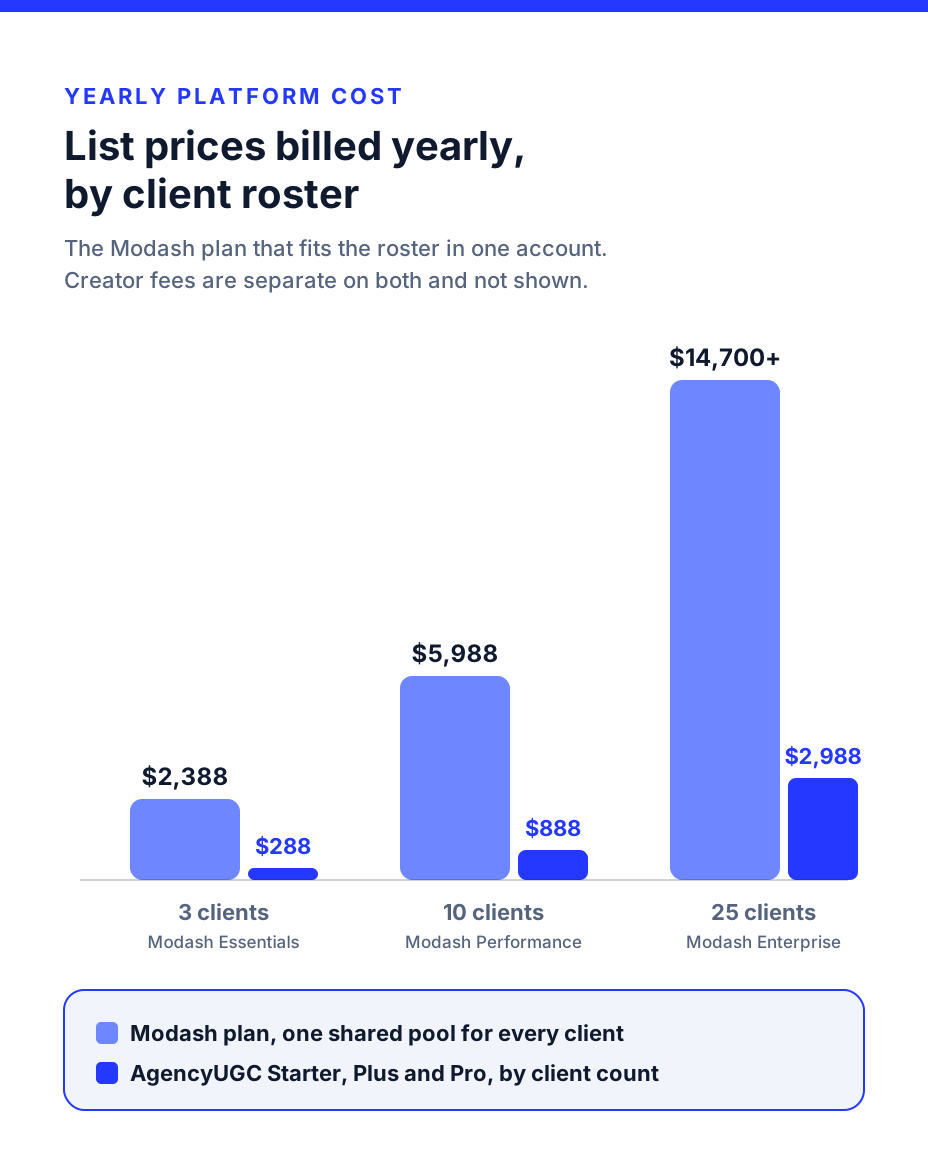
Here is how those list prices line up against an agency roster, both sides billed yearly. The Modash column assumes one account shared by every client, since that is how the plans are sold.
| Agency roster | Modash, billed yearly | What each client gets from the Modash pool | AgencyUGC, billed yearly |
|---|---|---|---|
| 3 clients | Modash Essentials, $2,388 | About 100 opened profiles and 50 email unlocks a month each | Starter, $288 |
| 10 clients | Modash Performance, $5,988, or ten Modash Essentials accounts at $23,880 | About 80 opened profiles and 25 tracked creators a month each on Modash Performance | Plus, $888 |
| 25 clients | Modash Enterprise, from $14,700 | Limits set in the Enterprise quote | Pro, $2,988 |
These are platform costs only. Creator fees are separate on both sides. On AgencyUGC creators are paid at the rate you agree, with no platform percentage on creator pay or ad spend. On Modash Performance, payments through Modash carry no fee up to $10,000 a year combined and 5% above that. Every AgencyUGC tier is listed on the AgencyUGC pricing page.
Who are Modash's competitors?
Modash's direct competitors in creator discovery are tools such as Favikon, Influencity and Upfluence, which also sell search over large creator databases. Broader influencer suites such as GRIN and CreatorIQ compete on CRM, payments and program management. Agencies that buy UGC content rather than run influencer outreach compare a third group: Insense, Billo, Influee, Collabstr and AgencyUGC.
| Platform | Built for | How it is priced | Client separation for agencies |
|---|---|---|---|
| Modash | Brand teams finding and managing creators, with Shopify sales tracking | Published monthly plans by usage limits; Enterprise by quote | One workspace per account |
| GRIN | Brands running influencer and affiliate programs for ecommerce | Monthly credit bundles | Credits draw down across every brand you run |
| Upfluence | Influencer, affiliate and gifting programs | Custom quote on a 12-month term | Priced by seats, not clients |
| CreatorIQ | Global brands and network agencies | Custom quote, annual contract | Co-branded client view inside an enterprise contract |
| AgencyUGC | Agencies running UGC for several clients | $49, $149 or $499 a month by client workspaces | One workspace per client |
We cost out the enterprise suites on the GRIN alternative for agencies, Upfluence alternative for agencies and CreatorIQ alternative for agencies pages. The UGC-first platforms sit side by side on the best UGC platforms for agencies comparison.
Is Modash worth it for a UGC agency?
Modash is worth it for an agency whose clients pay for influencer posts and affiliate sales on Shopify, because its search, fan matching and sales tracking are hard to replace. It is rarely worth it as the only tool for an agency that sells UGC videos, because most of the price pays for discovery limits the agency then has to split by hand across clients.
A quick test is last quarter's client requests. If they say find creators by audience, send discount codes and report sales per creator, Modash fits. If they say twelve unboxing videos and rights for paid social, you need a brief, a shortlist, a delivery check and a client report.
Where Modash is still the better choice
Be honest with yourself about these before you move anything. Modash's search covers 380M+ profiles, which is far wider than any vetted UGC pool, ours included. The influential fans feature shows creators who already follow the brand, which is often the warmest outreach list a client will ever have. Two-way Shopify sync, discount codes, gifting and sales per creator give a clean answer to the question a DTC founder asks most often. Payouts on Modash Performance and Enterprise save the work of paying creators one by one, and Enterprise pays out in 180+ countries in local currency.
AgencyUGC does none of those things. We do not search the open web for creators, sync with Shopify, track affiliate sales or pay creators on your behalf. An agency that depends on any of them for a client contract would be worse off switching, and the comparison table above says so for that reason.
Using Modash and AgencyUGC together
Many agencies do not need to choose. A workable split is to keep one Modash account for discovery and sales tracking, and run each client's briefs, deliverables, reports and invoices in its own AgencyUGC workspace. Modash finds the creator. AgencyUGC holds the brief, the usage rights log, the client rate and the report the brand sees.
What your clients see in AgencyUGC
AgencyUGC keeps the client side focused on your margin. On every paid plan, brief exports drop the AgencyUGC watermark. From Starter up, client reports show the rate you charge the client and never the creator's rate. Plus adds per-client reporting dashboards and client invoices at your client rate. Pro adds a client status page behind an access code, with an unbranded layout headed by your agency name, plus ROI reports as CSV. The full breakdown is on the white label UGC platform for agencies page.
The first brief runs as a one-off demo before you create an account. Use a live client campaign, compare the matched creators with what you would have found in Modash, and decide with real names in front of you.
Questions agencies ask before they switch
Run a brief for a client you manage in Modash
Use the platform, content type, niche and budget of a real client campaign and see matched creators in about two minutes. No account needed for the first brief.
- Modash pricing for agencies, every tier and limit
- Best UGC platform for agencies, platforms priced side by side
- GRIN alternative for agencies
- Upfluence alternative for agencies
- CreatorIQ alternative for agencies
- GRIN vs Upfluence for agencies
- White label UGC platform for agencies
- AgencyUGC pricing, Starter, Plus and Pro
- CreatorIQ Alternative for Agencies and CreatorIQ Competitors Priced for a Real Client Roster
- Upfluence Alternative for Agencies and Upfluence Competitors Compared Without an Annual Contract
- Influee Alternative for Agencies and Influee Competitors Compared Without the 10% Fee